


Why Pay-Per-Click Management Is Essential for Business Growth

Pay-per-click management is the disciplined, ongoing process of building and optimizing your paid media program to maximize profitable growth. It blends strategy, creative, data science, and engineering to ensure every dollar drives qualified demand and measurable revenue. This process involves everything from keyword research and bid strategy to ad creative, landing page optimization, and continuous performance analysis.
PPC can produce results within hours, but it can also drain budgets without a conversion framework. Unlike SEO, which compounds over time, paid traffic stops the moment spend stops—so strategic management is non-negotiable.
I’m Zack Bowlby, CEO and Founder of ROI Amplified. Over the past decade, I’ve managed over $100M in ad spend for 200+ companies. Treating PPC as a revenue system—not just a traffic source—has helped clients achieve outcomes like a 348% increase in ROAS for an e-commerce brand.
Glossary for Pay-per-click management:
Understanding the PPC Landscape: More Than Just Paying for Clicks
If you’ve seen ads at the top of Google’s results, you’ve seen PPC in action. Pay-per-click advertising means you pay when someone engages by clicking your ad. Think of it as buying qualified attention in the exact moment of intent.

Here’s why businesses leverage PPC:
- Rapid Visibility: Launch and appear atop search results within hours.
- Measurable Performance: Track impressions, clicks, conversions, and revenue.
- Budget Flexibility: Scale spend up or down daily without long commitments.
- Targeted Reach: Layer location, device, audience, and keyword intent.
Without proper management, PPC is guesswork. The landscape is competitive, auctions are dynamic, and waste can accrue quickly on irrelevant traffic. To prevent this, managers use tools like negative keywords. When visitors don’t convert, remarketing strategies re-engage them across channels to increase total conversions.
PPC, SEO, and Digital Marketing: How They Work Together
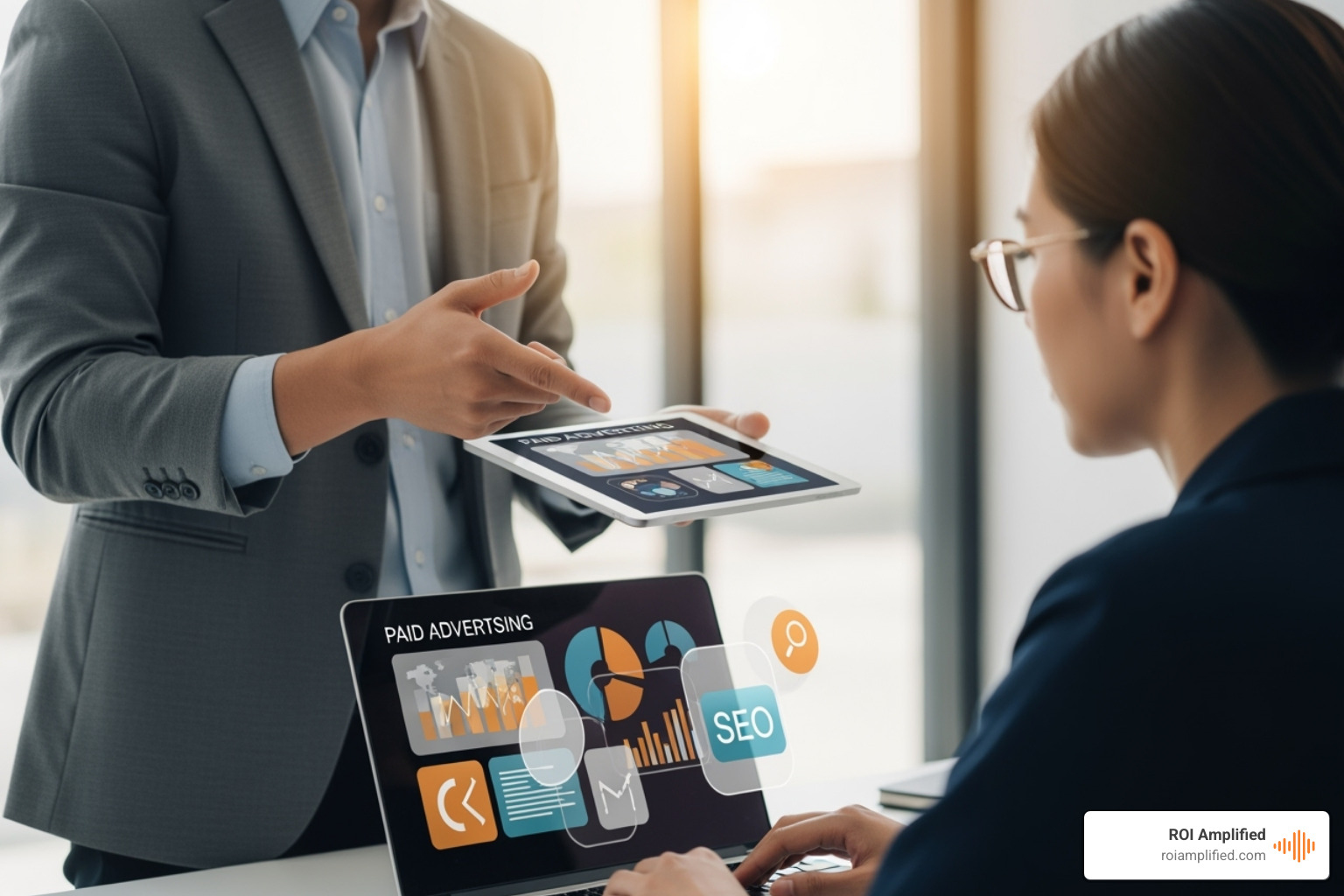
A common misconception is that PPC and SEO compete. They’re complementary pillars under Search Engine Marketing (SEM). PPC delivers immediate demand capture; our Search Engine Optimization (SEO) Services build durable, compounding traffic.
| Feature | PPC (Paid Search) | SEO (Organic Search) |
|---|---|---|
| Cost | Pay per click; budget-dependent | Free clicks; investment in optimization |
| Speed of Results | Immediate; live within hours | Slower; typically takes months |
| Control | High control over copy, targeting, budget | Less direct control; influenced by algorithms |
| Sustainability | Stops when you stop paying | Generates sustainable long-term traffic |
Run together, they inform and amplify each other. PPC reveals converting keywords and audiences you can prioritize for SEO content. SEO builds brand trust that improves paid conversion rates. Adding social signals via Integrating SEO and Social Media further strengthens both.
The Blueprint for Successful Pay-per-click Management
Effective Pay-per-click management aligns bidding, relevance, and user experience. In every search, an instant auction determines your ad’s position. It’s not only about bid size—relevance wins. Google’s Quality Score, informed by expected CTR, ad relevance, and landing page experience, can lower costs and lift positions for well-matched ads.

Different campaign types map to different goals. Search captures active intent, display builds reach, social targets defined audiences, and shopping showcases products directly in results. The aim is to spend smarter—pairing intent with the right format and message. Our Search Advertising Services use this framework to prioritize efficiency and revenue impact.
Core Strategies: From Keywords to Conversions
Start with intent-driven research. Using keyword planning tools, identify terms that signal the action you want (buy, book, demo). Prioritize long-tail keywords for lower CPCs and higher intent. Add negative keywords to block waste (e.g., “free,” “jobs,” “DIY”).
Group keywords into tightly themed ad groups so your ad copy and extensions mirror the query. Align budget to the best economics, not just volume. Implement robust conversion tracking for forms, calls, purchases, and high-value micro-actions. Where possible, bring CRM data back into the platform to improve optimization with actual revenue.
The Optimization Cycle and Post-Click Experience
Launch is findy; optimization is where scale and efficiency happen. Use A/B testing to iterate headlines, descriptions, CTAs, and landing layouts—see our A/B Testing Insights. Choose bidding strategies that match your goals (e.g., target CPA or ROAS), and manage them with real-time performance signals like Click-through Rate (CTR), conversion rate, and search term reports. Focus decisions on cost per conversion and profit, not just CPC. For methodology, see Measuring ROI in PPC.

The click is the midpoint, not the finish line. A high-performing landing experience should have:
- Relevance: Headline and offer match the ad’s promise.
- Mobile Optimization: Fast, intuitive, and accessible on every device.
- Fast Load Speed: Speed directly impacts bounce and conversion.
- Clear Call-to-Action (CTA): Singular, prominent action with minimal friction.
Improving the post-click journey raises Quality Score, reduces CPC, and lifts conversion rates. Our Landing Page Optimization Services build conversion-focused pages that align messaging from keyword to form.
The Big Decision: In-House PPC Team vs. Partnering with a Professional Agency
As you scale Pay-per-click management, decide whether to build in-house capability or partner with specialists. The right path depends on speed-to-market, sophistication needs, and total cost of ownership.

Weighing the Pros and Cons for Your Business
The In-House Route Full control, deep brand context, and immediate collaboration. Hidden costs include salaries and benefits, recruiting, training, tool stacks, and keeping pace with platform changes. Coverage can be thin across strategy, analytics, creative, CRO, and engineering.
The Agency Partnership Access senior practitioners, proven playbooks, and cross-industry benchmarks—often at lower total cost than staffing all roles internally. Agencies provide surge capacity, advanced tooling, and rigorous QA. The tradeoff is a short onboarding period to transfer brand nuance. See the Benefits of Outsourcing PPC.
Consider partnering with an agency if you:
- Lack deep PPC expertise internally.
- Have limited resources and a stretched-thin team.
- Are experiencing underperforming campaigns that burn budget.
- Are ready to scale your growth efficiently.
Choosing Your Path to PPC Success
Expert Pay-per-click management reduces acquisition costs, improves conversion rates, and makes ROI transparent. At ROI Amplified, our PPC Management Services use a revenue-first approach, retainer-based pricing, and 24/7 live reporting—so you always see what’s working. Learn more about Why Choose ROI Amplified and how we align paid media to your pipeline and revenue goals.
Digital advertising evolves rapidly—automation, AI, new formats, and privacy changes reward teams that iterate quickly. Choose the path that delivers the strongest, most predictable return on your ad spend. For many brands, the fastest route to reliable growth is a specialized partner focused on outcomes.

