


Digital Marketing Agency Pricing Guide: Avoid 7 Cost Traps
Why Digital Marketing Agency Pricing Remains a Mystery for Most Businesses
A digital marketing agency pricing guide can feel like searching for a needle in a haystack. You’ve probably experienced the frustration: one agency quotes $2,000 per month, another wants $15,000, and a third won’t even give you a number without a “findy call.”
Quick Answer: Digital Marketing Agency Pricing Ranges
- Small businesses: $2,000 – $6,000/month typically
- Enterprises: $100,000+/month for comprehensive campaigns
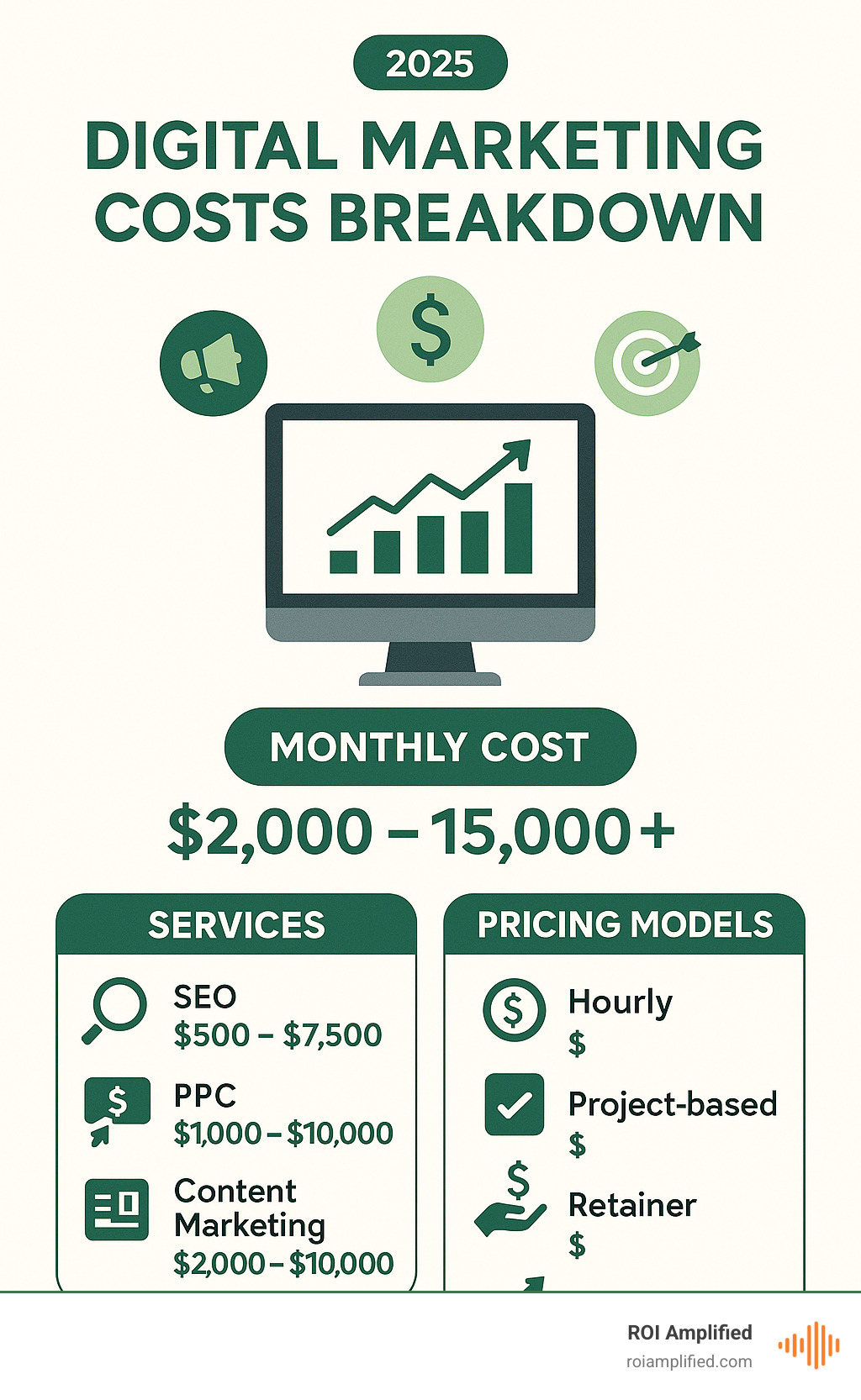
- Common pricing models: Hourly ($50-$300), Project-based ($500-$50,000), Retainer ($1,000-$50,000+/month), Performance-based (varies widely)
- Individual services: SEO ($500-$7,500/month), PPC management ($100-$10,000/month), Content marketing ($2,000-$10,000/month)
The confusion isn’t accidental. Many agencies use vague pricing because digital marketing costs depend on dozens of factors – from your industry’s competition level to whether you need basic social media management or a complete revenue-generating machine.
Here’s what makes this especially tricky: the digital marketing market is expected to reach $689 billion by 2028, which means more agencies are entering the space with wildly different pricing strategies. Some compete on price alone. Others charge premium rates for proven results.
The real problem isn’t just the price – it’s understanding what you’re actually buying and whether it will move your revenue needle.
I’m Zack Bowlby, and I’ve personally managed over $100M in ad spend while building ROI Amplified into an agency that’s driven over $1B in tracked client revenue. This digital marketing agency pricing guide will cut through the confusion and show you exactly what different pricing models mean for your business outcomes.
Decoding the 7 Most Common Agency Pricing Models
Picture this: you’re shopping for a car, but every dealership uses a completely different pricing system. One charges by the hour you’ll drive it, another wants a monthly fee regardless of usage, and a third won’t tell you the price until you prove how much money you’ll make from owning it.
Welcome to digital marketing agency pricing! Each pricing model creates a different relationship between you and your agency, affects how predictable your budget will be, and determines how easily you can scale up or down.

The truth is, there’s no universal “best” model. What works perfectly for a startup might be completely wrong for an enterprise company. At ROI Amplified, we believe in transparent pricing that aligns our success with yours. Let’s break down what you’ll actually encounter out there.
Hourly & Project-Based Pricing
Think of these as the “pay as you go” options of digital marketing. They’re straightforward, which makes them popular for specific tasks or when nobody’s quite sure how much work something will take.
Hourly rates are exactly what they sound like – you pay for the time spent on your account. This works great for consulting calls, small website tweaks, or when you need expert advice but aren’t ready for ongoing support. Expect to see rates anywhere from $50 to $500 per hour, with most SEO specialists charging around $148 and PPC experts around $152.
The upside? You only pay for actual work time. The downside? Costs can spiral quickly if scope creep sneaks in (and it usually does).
Project-based fees flip the script by charging a fixed price for specific deliverables. Whether it’s a website redesign, new branding initiative, or a complete digital marketing audit, you know exactly what you’ll pay upfront. These projects typically range from $500 for simple tasks to $50,000 for complex, comprehensive initiatives.
This approach gives you budget certainty, but it also means less flexibility once the project starts. Changes often mean additional costs, so getting the scope crystal clear from day one is crucial.
Retainer & Packaged Services
If you’re looking for ongoing support rather than one-off projects, retainers and packages are where things get interesting. These models create true partnerships between agencies and clients.
Monthly retainers are the subscription model of digital marketing. You pay a fixed monthly fee, and the agency provides ongoing services like SEO campaigns, social media management, and content creation. Most retainers fall between $1,000 and $50,000+ monthly, with SEO-focused retainers typically running $2,500 to $7,500.
For agencies, retainers provide stable revenue that lets them think long-term about your strategy. For you, it means consistent support without negotiating every small task. It’s like having an in-house marketing team without the overhead.
Packaged services bundle multiple services into neat tiers – think “Basic,” “Standard,” and “Premium” options. Instead of piecing together individual services, you get a comprehensive approach at a set price.
At ROI Amplified, our retainer-based approach includes Search Engine Optimization, AI Search Engine Optimization, Google Ads management, social media marketing, content creation, website maintenance, HubSpot implementation and management, plus marketing automation setup. This comprehensive approach ensures all your marketing efforts work together instead of competing against each other.
Value-Based & Performance-Based Pricing
These models get really interesting because they tie agency compensation directly to your business results. It’s where “we succeed when you succeed” becomes more than just a tagline.
Value-based pricing sets fees based on the impact the work will have on your business, not just the hours involved. If an agency’s conversion rate optimization work will generate an extra $100,000 in revenue, they might charge $20,000 instead of billing 100 hours at $150 each.
This approach rewards expertise and results over time spent. However, it requires serious trust between both parties and crystal-clear ways to measure that value.
Performance-based pricing takes it even further by tying fees directly to measurable outcomes like leads generated, sales conversions, or revenue increases. You might pay a base fee plus bonuses for hitting specific targets. Performance metrics are key here – both sides need to agree on what success looks like.
The appeal is obvious: you only pay for proven results. The complexity comes in setting up proper tracking and dealing with external factors that might affect performance (like economic downturns or industry changes).
Hybrid (or Mixed) Model
Why choose just one pricing model when you can combine the best parts of several? Hybrid models are becoming increasingly popular because they offer flexibility that single models can’t match.
For example, you might pay a monthly retainer for ongoing SEO work, a project fee for a website redesign, and performance bonuses for exceeding lead generation targets. This approach lets agencies customize solutions for your specific needs while balancing predictability with performance incentives.
HubSpot’s research on model popularity shows that 43% of agencies now use some combination of pricing models. This flexibility reflects how diverse digital marketing has become – there’s rarely a one-size-fits-all solution anymore.
The key to making hybrid models work is clear communication about each component. You should understand exactly what you’re paying for and when, whether it’s the monthly retainer portion or the performance bonuses.
What to Expect: Average Costs for Key Digital Marketing Services
Let’s get to the numbers you’ve been waiting for. While every business is unique, having concrete pricing benchmarks helps you make informed decisions about your marketing budget. Think of this digital marketing agency pricing guide as your roadmap for smart investment allocation.
One crucial thing to remember: the figures I’m sharing represent management fees. Your actual ad spend on platforms like Google or Facebook comes on top of these costs.

SEO & PPC Advertising Costs
These two powerhouses form the backbone of most successful digital marketing strategies. They’re also where businesses see some of their strongest returns.
Search Engine Optimization (SEO) is your long-term growth engine. While it takes time to build momentum, the results compound beautifully over months and years. Most businesses invest $500 to $7,500 per month for professional SEO services, with the sweet spot being $2,500 to $5,000 monthly for comprehensive campaigns.
Here’s what makes SEO pricing tricky: it’s not just about ranking for keywords anymore. At ROI Amplified, we’ve expanded beyond traditional SEO to include AI SEO, Generative Engine Optimization (GEO), and Answer Engine Optimization (AEO). These newer approaches help you show up in AI-powered search results and voice queries – areas your competitors might be ignoring.
For enterprise-level businesses with complex websites and competitive markets, SEO investments can reach $20,000+ per month. But remember, unlike paid ads, your SEO results don’t disappear when you pause spending.
Pay-per-Click (PPC) Advertising gives you immediate visibility, which is why it pairs so well with SEO’s long-term approach. Management fees typically run $100 to $10,000 per month, depending on campaign complexity and ad spend levels.
Here’s the exciting part: businesses make $2 for every $1 spent on Google Ads on average. Some of our clients at ROI Amplified see even better returns when we optimize their campaigns properly. Just remember, these management fees don’t include your actual ad spend – that goes directly to Google, Facebook, or whichever platforms you’re advertising on.
Content & Social Media Marketing Costs
Content marketing and social media work hand-in-hand to build your brand’s authority and keep your audience engaged. The investment here pays dividends in trust, loyalty, and organic reach.
Content marketing is where the magic happens for long-term growth. Most businesses invest $2,000 to $10,000 per month for comprehensive content strategies. This might seem like a significant investment until you realize that content generates 3x more leads than traditional marketing while costing significantly less.
What does this investment get you? Think blog posts that answer your customers’ burning questions, videos that showcase your expertise, and downloadable resources that turn visitors into leads. At ROI Amplified, our content creation and blog creation services are designed to fuel your organic growth while establishing you as the go-to expert in your field.
Social media marketing keeps you connected with your audience where they spend their time. Investment levels vary widely here – from $100 to $5,000 per month – depending on how many platforms you’re active on and whether you’re running paid social campaigns.
The beauty of social media is its immediate feedback loop. You post something valuable, and you can see engagement within hours. It’s also where customer service happens now, making it essential for brand reputation management.
Email Marketing & Web Design Costs
Don’t let anyone tell you email is dead – it’s actually one of your highest-ROI channels. And your website? It’s working for you 24/7, so getting it right matters more than ever.
Email marketing delivers incredible value for a relatively small investment. Most businesses spend $51 to $1,000 monthly on email marketing services. The return? Email marketing has an unparalleled ROI, often generating $36 to $44 for every dollar invested.
This isn’t about sending generic newsletters anymore. Modern email marketing involves sophisticated automation sequences, personalized content based on user behavior, and integration with your CRM system. When done right, email marketing turns one-time buyers into lifelong customers.
Web design and development is where first impressions happen. Most businesses invest $501 to $5,000 annually for ongoing website maintenance and updates, though initial design projects can range from $5,000 to $20,000 for custom work.
Your website needs to do more than look pretty – it needs to convert visitors into leads and customers. At ROI Amplified, our web design and development approach focuses on creating sites that are both visually appealing and conversion-optimized. Plus, with ongoing maintenance around $499 per month, you can keep your site secure, fast, and up-to-date without the headaches.
The key takeaway? These investments work best when they’re integrated. Your SEO content feeds your social media. Your social media drives traffic to your website. Your website captures emails. Your emails nurture leads into customers. It’s a beautiful, profitable cycle when executed properly.
Your Strategic Digital Marketing Agency Pricing Guide
Now comes the fun part – turning all this pricing knowledge into a strategic advantage for your business. Think of this digital marketing agency pricing guide as your roadmap to making smart investment decisions that actually move your revenue needle.
The truth is, finding the right digital marketing partner isn’t about hunting for the lowest price tag. It’s about understanding what drives costs and finding an agency that delivers real value for your investment.

Factors That Influence Your Final Price
Your final digital marketing investment depends on several key factors that agencies consider when creating proposals. Understanding these helps you evaluate quotes more effectively.
Agency experience and size play a huge role in pricing. Larger agencies with proven track records and specialized teams naturally command higher fees – but they also bring refined processes, advanced tools, and deep expertise. A large firm might charge over $20,000 monthly, while freelancers typically range from $500-$2,000.
Geographic location significantly impacts costs. Agencies in major metropolitan areas like Los Angeles or Washington D.C. have higher overhead costs, which translates to higher rates. A U.S.-based agency might charge $3,000-$10,000 per month for services that an offshore agency provides for $1,000-$5,000.
Your industry’s competition level can make or break your budget. Highly competitive niches like legal or finance require more aggressive (and expensive) strategies to break through the noise. A bail bond company might pay 50% more for Google Ads than a pest control company simply due to keyword competition.
Project scope and complexity directly influence pricing. A comprehensive multi-channel campaign with custom analytics and advanced automation costs significantly more than basic social media management. The more moving parts, the higher the investment.
Timeline expectations also affect costs. Need results yesterday? Agencies may need to allocate more resources, use aggressive paid strategies, or work on accelerated timelines – all of which increase costs.
Market demand plays a role too. When 80% of buyers compare prices between competitors, agencies must balance competitive pricing with delivering quality results.
Your Digital Marketing Agency Pricing Guide for Small Businesses vs. Enterprises
The reality is that small businesses and enterprises have vastly different needs – and budgets to match.
Small businesses typically allocate $2,000-$6,000 monthly for digital marketing. At this level, the focus should be on cost-effective strategies that deliver maximum impact. Think local SEO to dominate your neighborhood searches, targeted Google Ads that reach ready-to-buy customers, and foundational content marketing that builds trust over time.
Small businesses are naturally price-sensitive, so every dollar needs to work harder. The key is finding an agency that understands this reality and designs solutions for clear, measurable ROI within a manageable budget.
Enterprise companies often invest $100,000+ monthly in digital marketing initiatives. These organizations require comprehensive multi-channel campaigns, advanced analytics, international SEO strategies, and sophisticated marketing automation systems.
Enterprises need agencies that can handle complex integrations, manage multiple stakeholders, and scale strategies across diverse markets. Services like HubSpot implementation and management become crucial for coordinating these large-scale efforts.
The resource allocation differs dramatically too. While small businesses might focus on 2-3 core channels, enterprises often need presence across 10+ marketing channels simultaneously.
How to Evaluate Proposals and Measure ROI
Receiving a digital marketing proposal shouldn’t feel like deciphering ancient hieroglyphics. Here’s how to cut through the fluff and focus on what matters.
Look for crystal-clear deliverables in every proposal. Does it explicitly state what services you’ll receive, how often, and what the expected outputs are? Vague promises like “we’ll boost your online presence” are red flags. You want specifics: “We’ll publish 8 SEO-optimized blog posts monthly and conduct quarterly technical SEO audits.”
Pricing transparency separates professional agencies from the rest. The proposal should break down exactly what’s included, what’s not, and any potential additional costs. Hidden fees are relationship killers.
Reporting frequency and format matter more than you think. How often will you see performance updates? Monthly reports are standard, but 24/7 live reporting gives you real-time insights into your investment’s performance. At ROI Amplified, this transparency is built into our retainer-based pricing model.
Key Performance Indicators (KPIs) should align perfectly with your business goals. An e-commerce business needs different metrics than a B2B service provider. Make sure the proposed KPIs actually matter to your bottom line.
Calculating ROI is where many businesses struggle. The basic formula is simple: ROI = ((Revenue Generated – Marketing Costs) / Marketing Costs) x 100%. However, 44% of businesses struggle to measure ROI, especially for channels like social media where attribution gets murky.
The solution is robust tracking from day one. Monitor website traffic growth, lead generation, conversion rates, Customer Acquisition Cost (CAC), and Customer Lifetime Value (CLV). Set clear goals upfront and continuously optimize campaigns based on real data.
The goal isn’t just to spend money on marketing – it’s to invest in strategies that generate measurable business growth. The right agency will help you see exactly how every dollar contributes to your success.
Frequently Asked Questions about Agency Pricing
When you’re exploring digital marketing options, the same questions tend to pop up in every conversation. I’ve heard these concerns countless times from business owners trying to make sense of the digital marketing agency pricing guide landscape. Let me address the big ones directly.
How much should a business spend on digital marketing?
Here’s the golden rule that most successful businesses follow: invest 7-8% of your total revenue on marketing if you’re a small to medium-sized business. The U.S. Small Business Administration backs this recommendation, and for good reason – it typically provides the sweet spot between growth and sustainability.
Larger companies with proven ROI often push this up to 15% of their revenue. But here’s where it gets interesting – your industry plays a massive role in determining the right percentage.
Consumer services businesses typically invest around 19% of revenue because they’re fighting for attention in crowded markets. Education companies usually spend about 12%, while technology firms often allocate 10%. On the flip side, manufacturing businesses might only need 2% since they often rely more on relationships and referrals.
Think of it this way: if you’re a growing business in a competitive sector, you’ll likely need to invest more than a well-established company that already dominates its niche. The key is finding that balance where your marketing spend drives meaningful growth without straining your cash flow.
Is paying for a digital marketing agency worth it?
Absolutely, and here’s why this question comes up so often – business owners are naturally cautious about outsourcing something as critical as their marketing.
The expertise factor alone makes it worthwhile. When you partner with an agency like ROI Amplified, you’re not just hiring one person – you’re getting access to an entire team of specialists. SEO experts, PPC managers, content creators, web designers, and automation specialists all working on your account. Building this same team in-house would cost you significantly more in salaries, benefits, training, and the expensive tools they need.
Scalability is another huge advantage. Need to ramp up for a product launch? We can do that. Want to scale back during slower seasons? No problem. Try doing that with a full-time team, and you’ll quickly see why flexibility matters.
Then there are the advanced tools and technology. We invest in expensive software and platforms (like HubSpot, which we specialize in implementing and managing) that would be cost-prohibitive for most individual businesses to purchase and maintain.
Perhaps most importantly, outsourcing your marketing lets you focus on what you do best – running your business. Instead of trying to become a marketing expert on top of everything else, you can concentrate on serving customers and growing your core operations.
The numbers support this too – 94% of businesses report satisfaction with their digital marketing ROI when working with experienced agencies.
How does the wrong pricing structure affect my business?
This is where things can go sideways quickly, and I’ve seen the damage when businesses make poor choices.
Overpaying for services is the obvious risk. If an agency charges premium rates but delivers basic work, or if their hourly rate doesn’t match their actual output, you’re essentially throwing money away. But the opposite problem is often worse.
Choosing the cheapest option usually backfires. Those rock-bottom prices often signal an agency that lacks experience, resources, or strategic depth. They might promise the world but deliver underwhelming results that actually damage your brand and waste precious time. Cheap marketing that doesn’t work isn’t a bargain – it’s expensive.
Misaligned goals create another serious problem. If you’re paying hourly for lead generation when you really need conversions, the agency’s efforts won’t focus on what truly matters to your bottom line. Their incentives won’t match your success metrics.
Lack of transparency breeds frustration and distrust. Hidden fees, unclear deliverables, and vague reporting make it impossible to measure actual ROI. At ROI Amplified, our transparent approach with 24/7 live reporting eliminates these concerns entirely.
The biggest long-term damage comes from missed growth opportunities. Every dollar wasted on ineffective marketing is a dollar that could have been driving real results. This doesn’t just hurt your current campaigns – it stunts your business’s growth trajectory and competitive position.
The right pricing structure, on the other hand, aligns everyone’s interests and creates a true partnership focused on your success.
Conclusion: Finding a Partner, Not Just a Price Tag
Navigating digital marketing agency pricing guide territory doesn’t have to feel like decoding a secret language. You now understand the common pricing models, realistic costs for essential services, and the key factors that shape your investment. More importantly, you know what questions to ask and red flags to watch for.
Here’s the truth: the cheapest option rarely delivers the best results. We’ve seen too many businesses burned by agencies that promise the world for $500 a month, only to deliver generic content and vanishing act customer service. On the flip side, the most expensive doesn’t automatically mean the best either.
Focus on value and ROI, not just the initial price tag. The right agency becomes an extension of your team – someone who genuinely understands your business challenges, celebrates your wins, and adapts their strategies as you grow. Transparency should be non-negotiable, whether that’s in pricing, reporting, or simply picking up the phone when you call.
At ROI Amplified, we built our retainer-based pricing model around this philosophy. No surprise fees, no vague deliverables, no wondering if your investment is actually working. Our 24/7 live reporting means you can check your campaign performance at 2 AM if you want to (though we hope you’re getting better sleep than that).
Clear communication forms the foundation of every successful partnership. When your agency explains what they’re doing, why they’re doing it, and how it impacts your bottom line, you’re not just buying services – you’re investing in growth. Our in-house expertise spans everything from AI SEO and Google Ads to HubSpot management and marketing automation, but what really matters is how we use these tools to drive your specific business goals.
The digital marketing landscape will keep evolving, new platforms will emerge, and algorithms will shift. But the fundamentals remain the same: find a partner who’s as invested in your success as you are. Someone who sees beyond the monthly retainer to the long-term relationship you’re building together.
Ready to work with an agency that treats transparency as a feature, not a luxury? Partner with a transparent digital marketing agency that puts your ROI first, because that’s exactly what you deserve.

